16.11.2018
Focus on the sustainability of sun protection fabrics
The requirements for modern buildings are continuously increasing. National and international building certification standards, along with energy-saving goals, directly impact interior sun protection systems. Architects and property developers supported by erfal receive requirement-specific product and fabric recommendations for interior sun protection in commercial projects. A resource-efficient approach to raw materials is an integral part of our product selection.
Support for Building Certification Systems
We actively support architects and planners in fulfilling the criteria for the building certification systems DGNB, BREEAM, and LEED.

DGNB
DGNB (German Sustainable Building Council): This system assesses the entire lifecycle of a building based on six core areas (Environmental Quality, Economic Quality, Sociocultural and Functional Quality, Technical Quality, Process Quality, and Site Quality). To achieve Bronze, Silver, Gold, or Platinum awards, buildings must meet requirements that go significantly beyond statutory minimum standards.

BREEAM®
BREEAM®: This widely recognized certification system awards a seal of approval in four levels based on a scoring system across eight assessment categories (including Management, Energy, Health and Wellbeing, and Materials).

LEED
LEED (Leadership in Energy and Environmental Design): Developed by the U.S. Green Building Council, this system classifies buildings into four rating levels. The rating is based on a points system across six core areas (including Water Efficiency, Energy and Atmosphere, and Materials and Resources).
Certifications/Regulations

Cradle to Cradle
This framework assesses products according to the principles of a continuous circular economy. The objective is to ensure that materials can be returned to technical or biological cycles at the end of the product's lifecycle.
Greenguard
A voluntary product certification that establishes strict emission limits for over 360 volatile organic compounds (VOCs) as well as the Total Volatile Organic Compound (TVOC) emissions, aimed at supporting indoor air quality in commercial and public spaces.

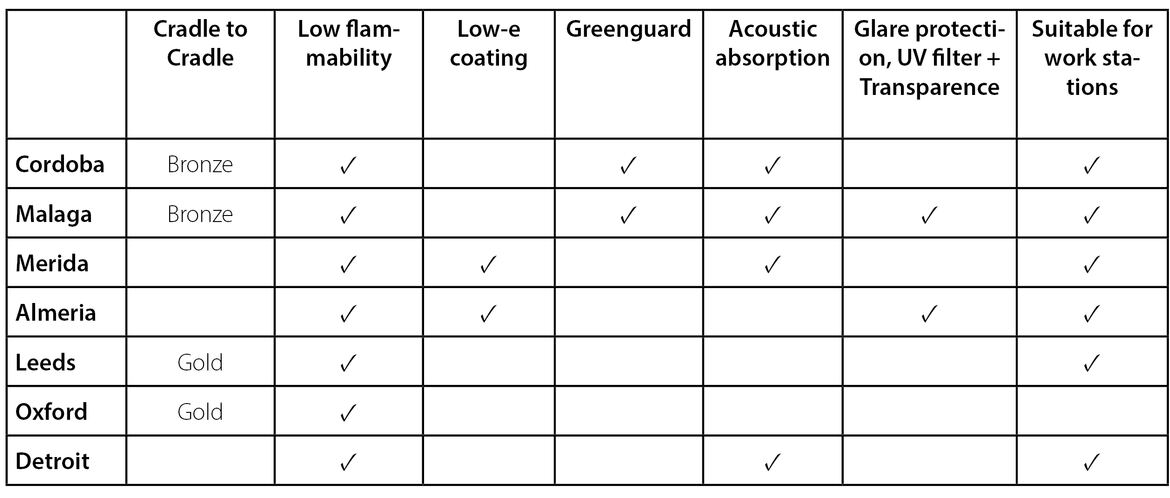
CORDOBA and MALAGA Qualities: These fabrics are certified according to the Cradle to Cradle Certified® Bronze Standard (Certificate No. XY, valid until ZZ). They consist of at least 65% recycled material (PET-recycled material derived from post-consumer bottles, approx. 6 PET bottles per square meter) and are technically 100% recyclable. By using recycled material, the direct consumption of crude oil for the yarn is avoided compared to the use of virgin polyester. The fabrics are flame-retardant according to DIN 4102 B1 and comply with the requirements of the EU REACH Regulation.

MERIDA and ALMERIA Qualities: Features a reflective Low-e coating. This coating supports indoor climate regulation by reducing solar energy heat gain in the summer and contributing to thermal insulation in the winter. This can lower the energy demand required for cooling and heating.

Indoor Air Quality and Acoustics: The CORDOBA, MALAGA, and MERIDA qualities hold the Greenguard Gold certification. Optimized indoor air quality and good room acoustic properties are proven to help reduce fatigue and loss of concentration in the workplace. The measured sound absorption coefficient (α-value) is 60% for CORDOBA and 30% for MALAGA.

The fabrics CORDOBA and MALAGA are absorbing a part of the sound and are damping the spread of sound waves. The measured α-value lies at 60% (for CORDOBA) or rather 30 % (for MALAGA).

The fabrics serve as effective glare protection at computer workstations. The MALAGA and ALMERIA qualities also ensure a clear view to the outside while reducing UV radiation by at least 96%.

These glare-protection fabrics feature a metallized backing for high reflection of solar energy. They are manufactured from an INGEO™ biopolymer PLA fiber, which is derived from plant starch. These fabrics have been awarded the Cradle to Cradle Certified® Gold certificate